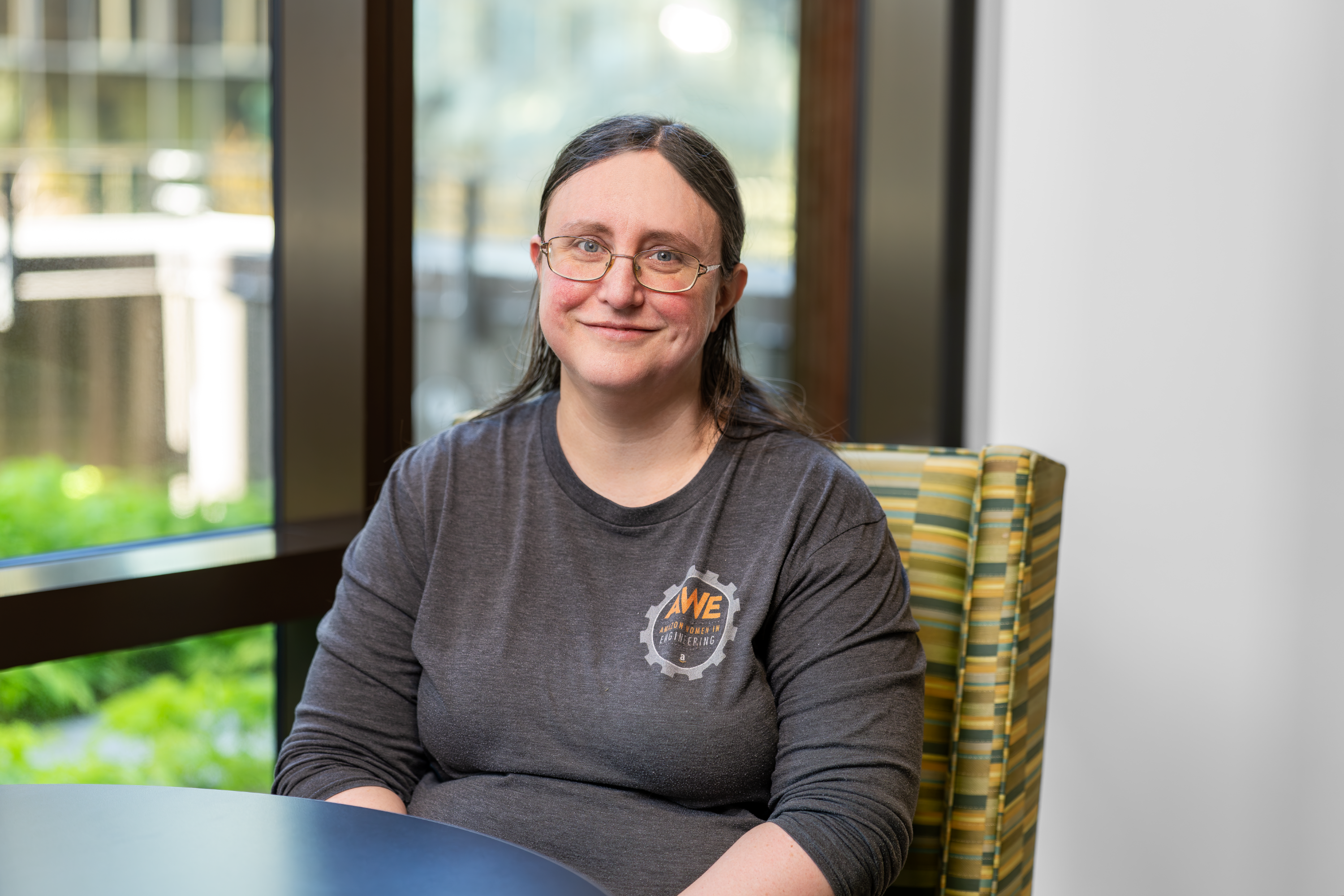
20 years at Amazon turned Christy into a leader. It never stopped her being an engineer.
A software development manager in AWS Batch on problem solving, force multiplication, and why she’s never left.
Ownership here is real
For Christy, a software development manager at AWS, ownership is her favorite Leadership Principle. As she puts it: when something isn’t working, it’s not about whose problem it is, but who’s in the best position to go solve it. Here, she reflects on her beginnings, the opportunities she’s had, and what keeps her at Amazon.
You’ve been at Amazon for over 20 years. How did that start?
I was in college, trying to figure out whether I wanted to go into industry or get an advanced degree. I went to the Grace Hopper Celebration of Women in Computing, and Amazon had a table there because some of our women leaders had driven up to Vancouver for it. I answered some questions, won a t-shirt, and left. It was on my radar, but it wasn’t the top thing.
Then the next week, I was in class covering web design, and my professor kept saying “Amazon pioneered this.” A lot of the conventions we take for granted as just normal web design were things Amazon helped invent. I got a callback, and some of the same women I’d met at the conference were the ones who did my phone screen, and on the team I joined. I started as a SDE straight out of college.
You say you still identify as an engineer, even though you’re a manager now. What does that mean to you?
For me, it’s about having that problem-solving mindset. Being able to look at a problem, break it down, come up with options, figure out the trade-offs, and then go make something better.
That hasn’t changed with the title. I don’t write code anymore, but the mindset is the same. The difference is that now I’m solving people problems alongside technical ones: where someone’s expertise sits, what kind of support they need, where processes are working, and where they’re not.
What has kept you here for two decades?
Two core things have kept me here for a long time. The first is that I work with awesome people. The second is that I can meet people anywhere and they really want to tell me what Amazon or AWS products they’re using. And to me, that’s the ultimate validation that we don’t just say we’re customer obsessed, we actually get it right.
The people part compounds over time. The internal mobility and the scale of Amazon mean there’s always something genuinely interesting to work on next. Every team I’ve been on has had people who chose to be there, solving those specific problems together. That energy carries you through the hard parts and makes the wins feel real.
You moved from retail into AWS in 2020. What was that transition like?
It was the first time I ever had to manage a team where I didn’t know anything about the underlying software. I couldn’t just go grab something and write code to learn it. I had to learn the system from a different angle entirely. That was uncomfortable at first, but it became one of the most valuable learning experiences I’ve had. When I later moved into AWS Batch, I was able to ramp up much faster because I’d already built that muscle.
How would you describe the culture around problem solving here?
The thing that has been really fun about working here is the extent to which you are really encouraged to build that community together and solve problems together.
One of my favorite Leadership Principles is ownership. When you see something that’s not working right, it’s not about whose problem it is. It’s about who’s in the best position to go solve it. That doesn’t mean you take on everything. But there’s real opportunity to spot a gap and either fix it yourself or find the right people who can.
Beyond my day job, I’m involved in Amazon Women in Engineering, Families, Mental Health and Well-Being groups, and our Bar Raiser program. Sometimes support looks like sitting down one-on-one with someone who’s stuck. Sometimes it’s creating documentation that helps people diagnose problems on their own. It depends on the situation.
What do you look for in great engineers?
We’re looking for people who are curious—who ask why, not just how—so they understand the reason for doing something and know when to raise questions. This is a team sport. We’re all working together to make great stuff for our customers.
I want people who can balance shipping something quickly for customers against the long-term need to keep making it better over time. And internally, we talk about force multiplication: the ability to make the group as a whole more effective at a rate that’s faster than you can personally be great at things. That’s what separates good engineers from the ones who really change how a team operates.